
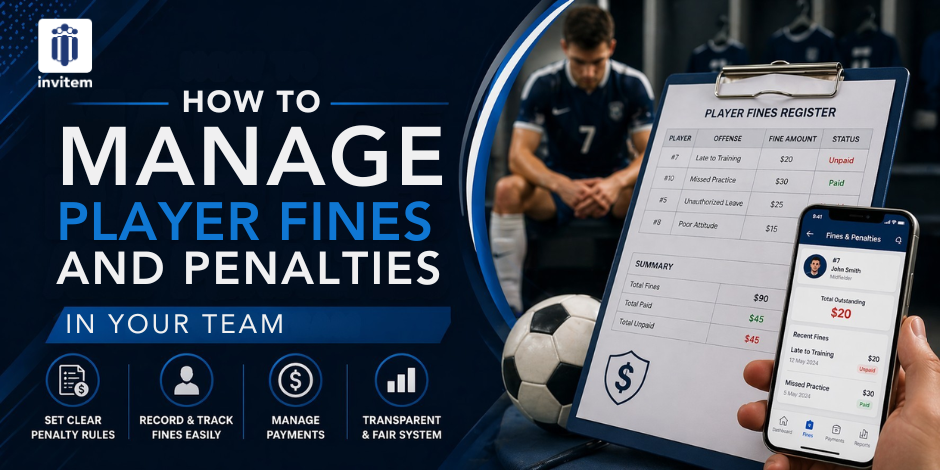
How to Manage Player Fines and Penalties in Your Team
Team fines are a tradition in many sports clubs. They create accountability, fund the end-of-season social, and add a layer of competitive banter that most squads genuinely enjoy, provided the system is fair, transparent, and actually enforced.
The problem is that most clubs run their fines system on a combination of a notes app, a group chat thread, and collective memory. group event planning app Someone tracks it informally. Someone forgot to add a fine. Someone disputes a fine because there is no written record. The pot at the end of the season is smaller than expected, and nobody is entirely sure where the discrepancy is.
This blog explains how to run a fair, transparent, and effectively enforced team fines system, one that players respect because it is consistent, and that actually results in the money being collected.
Why Team Fines Work When Managed Properly
Before getting into the mechanics, it is worth addressing why fines systems are worth maintaining at all.
Team fines, at their best, are not about punishment. They are about accountability. When everyone on the squad knows that forgetting kit costs a pound, and that everyone pays without exception, the standard of preparation rises. Players who might otherwise cut corners know there is a consistent, visible consequence.
Fines also create a fund that serves the whole club. End-of-season meals, kit contributions, and award nights are funded by the fines pot in many grassroots clubs. When players know that their fines go towards something they will enjoy, the culture around them shifts from ‘punishment’ to ‘contribution’.
The system only works when applied consistently and when records are transparent. If some fines are enforced and others are forgotten, if the pot is vaguely gestured at rather than clearly tracked, the system erodes, and players stop taking it seriously.
CTA – A fines system without transparent record-keeping is just selective punishment. Transparency is what makes it fair.
The Common Problems With Informal Fines Systems
No Written Record
‘I think Jamie owes three fines from the last month’ is a completely different thing from a timestamped record showing that Jamie was issued a fine on the 14th for forgetting his boots, on the 21st for arriving after warm-up had started, and on the 28th for not attending the disciplinary review.
The second version is something a player can review and either accept or dispute based on the facts. The first version is an invitation to an argument.
Money That Never Gets Collected
Fines that exist only as a running total in a notes app do not result in money changing hands until someone sits down to tally everything up, calculate individual totals, and start making direct payment requests. By that point, the amounts are large enough to feel significant, and disputes are inevitable.
The ‘Famous Five’ Problem
In most squads, the same three to five players pay their fines promptly,y and another group never quite gets around to it. Over a season, this creates resentment among the payers and an unofficial amnesty for the non-payers. Fairness requires that fines be collected from everyone or from no one at all.
Context Is Lost
‘Why do I owe fourteen pounds?’ is a question that requires someone to remember four separate incidents from across a season. Without written records showing what each fine was for and when it was issued, the history disappears, and the debt feels arbitrary.
How to Run a Team Fines System Properly
Agree and Publish the Fines Schedule
Before the season starts, the squad should collectively agree on the fines schedule. What are the fineable offences? How much does each one cost? Who has the authority to issue fines?
Common fines categories include:
- Kit offences:
Wrong kit for training, forgotten boots, no shin pads for a contact sport - Time offences:
Late to training, late to matches, missing warm-up - Commitment offences:
Missing training without notice, dropping out of a match on short notice - Behaviour offences:
Yellow or red cards, conduct issues during matches or social events - Miscellaneous:
Forgetting to respond to fixtures, losing match equipment
Publish this schedule where every player can access it, ideally in a digital format that can be referenced at any time. Invitem’s Info Hub is the right place for this.
Issue Fines Immediately and Digitally
The most important discipline in a fines system is issuing fines at the point of the offence, not at the end of the session or the end of the month. Delayed fines feel more like accusations and less like consistent enforcement.
Invitem includes a dedicated Fines and Penalties feature. As a manager or admin, you can issue a fine to any group member from within the app. Each fine records:
- The member’s name
- The fine amount
- The reason
- The date and time it was issued
This creates an immediate, timestamped record that is visible to both the manager and the player. There is no ambiguity about what the fine was for or when it was issued.
Make Payment Easy
A fines system where collection requires separate manual effort will always have a gap between fines issued and fines collected. The solution is to integrate payment directly into the fines record.
In Invitem, players can see their outstanding fines and pay them directly through the app using Stripe, Apple Pay, or Google Pay. Payment updates the record automatically. The manager sees in real time which fines have been paid and which are outstanding.
There are no awkward cash transactions. No, I will get it to you this week. No envelope at training. Just a notification, a tap, and a payment confirmed.
Review the Fines Record Regularly
Monthly or after each match block, review the fines record with the squad, or at a minimum, make it visible to all members. Transparency is the mechanism that makes the system fair.
When players can see their own record and compare it to a running total visible to everyone, the social pressure to stay current increases. Nobody wants to be visibly the squad member with the largest outstanding balance.
Using Invitem’s Fines Feature: A Practical Walkthrough
Setting up and using the fines system in Invitem takes approximately ten minutes initially. Here is how it works in practice.
Issuing a Fine
Open your team group in Invitem. Go to the Fines section. Tap ‘Issue Fine’. Select the player, enter the amount, write the reason, and confirm. The fine is immediately visible to the player and recorded in the group’s fines log.
Player Receives the Fine
The player receives a notification of the fine through the app. They can open the fine to see the reason and amount. If they dispute it, the record shows the timestamp and the stated reason, which provides the basis for any conversation.
Player Pays the Fine
The player opens their fines list and taps ‘Pay’. They complete the payment through Stripe, Apple Pay, or Google Pay. The fine is marked as paid in the group record instantly.
Manager Reviews Fines
The manager sees an up-to-date record of all fines issued, which are paid, and who has outstanding balances. At any point in the season, the total pot is visible, and the breakdown by player is clear.
CTA – Invitem is one of the very few sports team apps and the only completely free one that includes a dedicated fines and penalties management system.
Making the Fines Culture Work: A Few Principles
Apply Fines Consistently
The most important rule is consistency. The same offence must attract the same fine regardless of who commits it. If the captain is exempt from late fines or the vice-captain gets informal warnings that other players do not, the culture around fines deteriorates. Everyone pays, or the system loses its credibility.
Keep Fines Proportionate
Fines should be significant enough to create a genuine incentive to avoid the offence, but not so large that they create financial stress or resentment. For most grassroots clubs, fines of between 50 pence and £ 5 per offence are appropriate. Match-level offences like a red card might attract a larger fine commensurate with the impact on the team.
Spend the Pot Visibly
When the end-of-season event is funded by the fines pot, make this explicit. Tell the squad what the total was, what was spent, and what the remainder went towards. When players see that their fines genuinely fund the night out, the culture around the system becomes positive rather than punitive.
Allow Disputes Through a Process
No manager is infallible. If a player believes a fine was issued unfairly, there should be a clear process for raising a dispute. A brief review by a captain or senior player, with the digital record as evidence, resolves most disputes quickly and without drama.
The Bottom Line
A well-run team fines system creates accountability, builds culture, and funds the events that bring a squad together. Run poorly with informal records, inconsistent enforcement, and awkward cash collection, it creates more problems than it solves.
Invitem’s fines feature gives you the tools to run a proper system: digital issue, timestamped records, in-app payment, and real-time tracking. It is the only completely free app that handles team fines as a core feature rather than an afterthought.
If your club runs a fines culture, you now have the right tool to do it properly.
CTA – Manage your team fines properly – free on Invitem.
Download Invitem free on iOS & Android – App Store and Google Play
Frequently Asked Questions
Does Invitem charge for the fines feature?
No. The fines and penalties feature is included in Invitem’s free offering. There are no additional costs to access or use it.
Can players see the full list of fines, or only their own?
Group admins and hosts control visibility settings. Managers can choose to make the full fines record visible to all members, which reinforces the transparency and fairness of the system, or restrict visibility to individual fines records.
What if a player refuses to pay?
The fines system creates a clear record of outstanding balances that can be discussed through the club’s normal channels. Most clubs handle persistent non-payment through conversations with the captain or committee review. The digital record provides the evidence base for those conversations.
Can fines be issued for social events as well as training and matches?
Yes. Invitem’s fines feature is not limited to sporting offences. It works equally well for social events players who commit to attending and do not show up, those who fail to meet agreed deadlines for payments or admin tasks, and so on.