
Organisation is not the most glamorous part of coaching. It does not win matches on its own, and it rarely gets mentioned in post-match analysis. But ask any experienced coach about the conditions that allow a team to perform at its best, and organisation almost always features near the top of the list.
When players always know when and where training is, when they receive reminders rather than relying on memory, when the coach has a clear record of what has been planned and what has been promised, and when shared information is permanently accessible rather than buried in a chat thread, the entire experience of being part of the team improves.
People show up more reliably. Misunderstandings happen less often. And the coach can focus on coaching rather than fielding the same logistical questions week after week.
Keeping a sports team organized in 2026 requires the right combination of tools, specifically a sports team scheduling app that integrates calendar management, information notes, event coordination, and communication into one platform. This blog explains exactly how to do it, step by step.
The Organisation Challenge Every Coach Recognises
Most coaches start out managing their team’s organisation through a combination of personal tools: a calendar app on their phone, a notebook for session plans, a group chat for communication, and perhaps a spreadsheet for tracking attendance and payments. Each of these tools works well individually. The problem is that they do not work together.
Fixtures noted in the coach’s personal calendar are not visible to players. Session plans in a notebook are inaccessible when the coach is on the touchline without it. Training reminders sent in the group chat disappear within hours. Payment records in one spreadsheet are not linked to the attendance data in another spreadsheet.
The result is a system that requires the coach to manually maintain connections between all these separate tools, connections that break down whenever something changes and that are entirely invisible to everyone except the coach themselves.
Building an Organised Team: The Five Pillars
Pillar 1: A Shared, Structured Calendar
The foundation of any organized sports team is a shared calendar that every member can access. Not a calendar that lives on the coach’s phone and is occasionally screenshot and shared in the group chat, but a live, always-current calendar that every member of the team can see in real time.
Invitem’s scheduling system creates exactly such a calendar. Every event created in Invitem training sessions, matches, tournaments, and social events appears in the group’s event feed and integrates with the personal calendars of members who choose to sync it.
When a fixture changes time or a training session is cancelled, all members see the update immediately. Nobody is working from an outdated schedule.
The sports team scheduling app functionality in Invitem also supports recurring events, so coaches do not have to recreate the same training session every week. Set it up once, and the app generates each occurrence automatically through the season.
Pillar 2: Event Information That Stays Accessible
Creating an event is just the beginning. Ensuring that all the information associated with that event remains accessible to members before, during, and after the event itself is what separates a well-organized club from one where the coach ends up re-answering the same questions every week.
Invitem’s event system allows coaches to attach comprehensive information to every event: the venue with Google Maps integration so members can navigate directly from the app; start time and expected duration; notes about kit requirements or specific session focus; capacity limits and RSVP instructions; and any documents relevant to the event (such as a referee’s contact details or a tournament schedule).
This information is available to every member with access to the event at any time, on their phone. The app, not the coach, answers the questions ‘What time does it start?’ and ‘How do I get there?’ for the fifth time this week.
Pillar 3: A Centralised Notes and Information Hub
Beyond individual events, every sports club has a body of standing information that every member needs to know and refer to regularly.
Training ground addresses, fixture lists, emergency contact details, kit ordering information, club rules, insurance documentation, and social media handles are all examples of information that changes infrequently but needs to be permanently and easily accessible.
In clubs managed through group chats, members occasionally share this information, but it quickly gets buried and eventually lost. New members who join mid-season have no reliable way to access it other than asking the coach or scrolling through months of chat history.
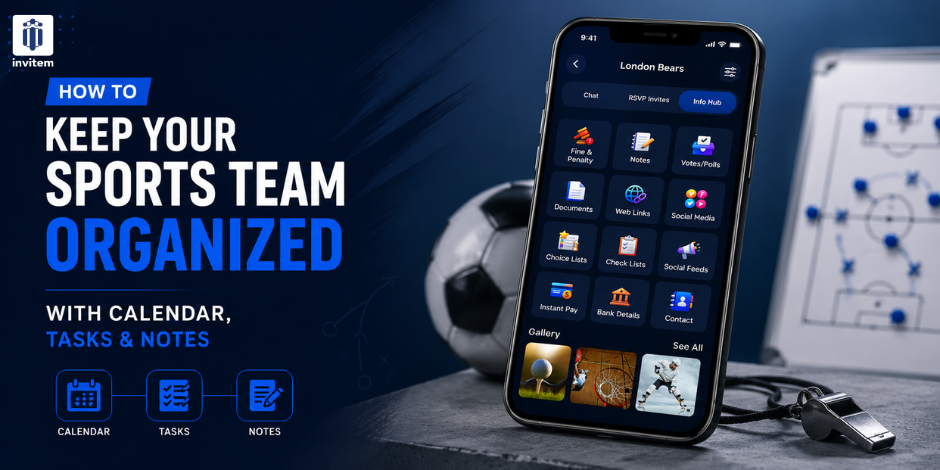
Invitem’s Info Hub solves these problems definitively. Coaches can organize all standing club information into clearly labeled sections, update it whenever things change, and make it instantly available to every member through the app. The Info Hub is the single source of truth for everything your club needs to know, and it stays that way.
Pillar 4: RSVP and Attendance Integrated With the Calendar
A calendar showing upcoming events is useful. A calendar that also shows who is coming to each event and allows members to confirm or decline their attendance directly is transformative.
Invitem integrates RSVP management directly with the event calendar, so coaches always have a real-time picture of who is attending each upcoming session.
Automatic reminders go out before events, prompting members who have not yet responded to confirm. Coaches can set capacity limits and waitlists, configure auto-accept rules for regular sessions, and track attendance patterns over time.
The practical effect of this integration is that the coach walks into every training session already knowing exactly who will be there, not because they spent an hour chasing confirmations, but because the system collected those confirmations automatically.
Pillar 5: Communication That Connects to the Calendar
The final pillar of organized team management is communication that is contextually connected to the events it relates to, rather than existing in a separate undifferentiated stream.
When communication occurs within the context of a specific event in Invitem’s event-specific chat, or through notifications linked to a specific fixture, it is automatically relevant and does not require context switching for the recipient.
A message about Saturday’s match appears in the Saturday match event, not in a general group chat where it competes with every other message the group has ever sent.
This contextual communication means that members can find all information related to a specific event in one place, and coaches can be confident that event-specific messages reach exactly the people they are intended for.
Practical Organisational Habits for Coaches Using Invitem
Having the right platform is necessary but not sufficient. Coaches who maximize a scheduling app for sports teams combine the right tools with consistent organizational habits. Here are the practices that make the most significant difference.
Plan the Full Season Upfront
At the start of every season, take an hour to enter all known fixtures, training sessions, and events into Invitem as recurring events. This gives the whole team immediate visibility of the season’s schedule, reduces the number of ‘when is the next match?’ questions to zero, and creates a baseline that can be updated as things change.
Update the Info Hub Before the Season Starts
Before the first training session, make sure the Info Hub contains everything members need to know: training locations, kit requirements, coach contact details, payment information, and club rules. Populating this information once at the start of the season prevents dozens of individual queries throughout the year.
Use Event Notes for Session-Specific Information
Every event in Invitem has a notes field. Use it. A training session note might include the session focus (‘working on set pieces today’), any kit requirements (‘bring bibs’), or specific instructions (‘meet at the back entrance, not the main car park’). Members who check the event, which the app’s reminders actively encourage, have everything they need without asking.
Review Attendance Patterns Monthly
Invitem’s attendance records build up over time into a valuable dataset. Take ten minutes each month to review which players have been attending consistently, which have missed multiple sessions, and whether certain types of sessions generate lower attendance.
This information informs selection decisions, helps coaches identify players who might be disengaging, and provides an objective basis for conversations about commitment.
Set Recurring Events for Seasonal Changes
When training locations, times, or formats change with the seasons, such as switching from outdoor to indoor venues in winter, simply update the recurring event settings in Invitem once, and the system will automatically propagate the change to all future occurrences. No need to update individual sessions or re-communicate the change through the group chat.
The Result: A Team That Runs Itself
When all five pillars of team organisation are in place a shared calendar, accessible event information, a centralized info hub, integrated RSVP, and contextual communication the administrative load on the coach drops dramatically.
The team develops its own rhythm. Members know what is expected of them, have access to the information they need, and receive reminders automatically rather than relying on the coach to prompt them individually.
This is what it looks like when a sports team genuinely runs itself as an organisation. It does not happen by accident. It is the product of the right tools, consistently applied. But once it is in place, it is remarkably self-sustaining
Conclusion
Keeping a sports team organized does not require a complex or expensive system. It requires the right platform, one that integrates scheduling, information management, RSVP, and communication into a single interface that every member of the team can access from their phone.
Invitem is that platform. As a free sports team scheduling app with full calendar integration, a powerful Info Hub, advanced RSVP tools, and structured group communication, it provides everything coaches and club managers need to run an organized, professional team at no cost, on any device.
Get your team organized today. Download Invitem for free on iOS and Android to set up your full-season calendar in under an hour.
Frequently Asked Questions (FAQs)
1. What is the best free sports team scheduling app in 2026?
Invitem is one of the most comprehensive free sports team scheduling apps available. It includes a shared team calendar with recurring events, Google Maps integration, RSVP and attendance tracking, and a permanent Info Hub, all at no cost on iOS and Android.
- Can I create recurring training sessions in a team management app?
Yes. Invitem supports creating recurring events, so coaches can set up a regular training session once and have it automatically appear on the team calendar for each occurrence throughout the season.
- How do I share fixture schedules with my whole team easily?
Create all fixtures as events in Invitem, and they are instantly visible to every member of the group. Members can also sync Invitem events with their personal device calendar so fixtures appear alongside their personal schedule.
- What is an Info Hub in a team management app?
Invitem’s Info Hub is a permanent, organized information space within every group where coaches can store and update key club information, venues, training times, contacts, documents, and notes so members always have access without searching through chat history.
- Can I track which players attended each training session over time?
Yes. Invitem records RSVP responses and physical attendance confirmation for every event, building a complete attendance history across the season. Coaches can review attendance patterns over time to inform selection and identify disengagement early.